
Results
-
 £89.95
Songs of Ascent - Jonathan Bates
DURATION: 14 minutes. DIFFICULTY: Championship. 'Songs of Ascent' was composed for the Royal Northern College of Music Brass Band, as part of their programme for the 2019 RNCM Festival of Brass. In my view, the festival itself is the leading showcase for original contemporary music for the medium (in a concert setting) in the world and therefore an ideal place to explore new ideas and sounds, which was a notion fundamental to the construction of this work. The piece is subtitled 'Out of the Depths, I cry to you, O Lord'; the opening line of Psalm 130 (which forms part of a set of 15 psalsm, 120-134 known as the Songs of Ascent") which forms the main inspiration for much of the musical material. Following an extended opening for four individual tuba lines, there are a number of solos for members of the band off stage, with bleak and deep accompaniment lines, reflecting the words of Psalm 130. Amongst these 'songs of ascents', the most common and strong themes are repentance and redemption; with the central core of this work emerging 'from the depths' to reveal one of very few calming and reflective passages of the work utilising the tune of 'Guide Me O Thy Great Redeemer' in a new setting, featuring the Solo Horn and Bass Trombone, before returning to the ethereal and dark timbres that form much of the music up to this point. In terms of compositional technique, this work is solely based on a set of 4 9-note scales in their various unique transpositions (below). Each of these scales provide a set of 2 whole tone scales, 6 minor triads, 6 major triads and is built on 9 augmented triads. Whilst most of the music in this work is based melodically on the set of notes (heard right at the outset in the motif in the tuba line), the central section delves into the harmonic capabilities of these 'modes', using a number of the 7 'keys' which can be derived from the minor & major chords derived in each scale. All 4 scales are used independantly to each other, with whole sections of the work focussing on each mode. 'Songs of Ascent' was selected as the set work for the Championship Section at the Butlin's Mineworker's Championships in 2020.
In Stock: Estimated dispatch 1-3 working days
-
 £90.00
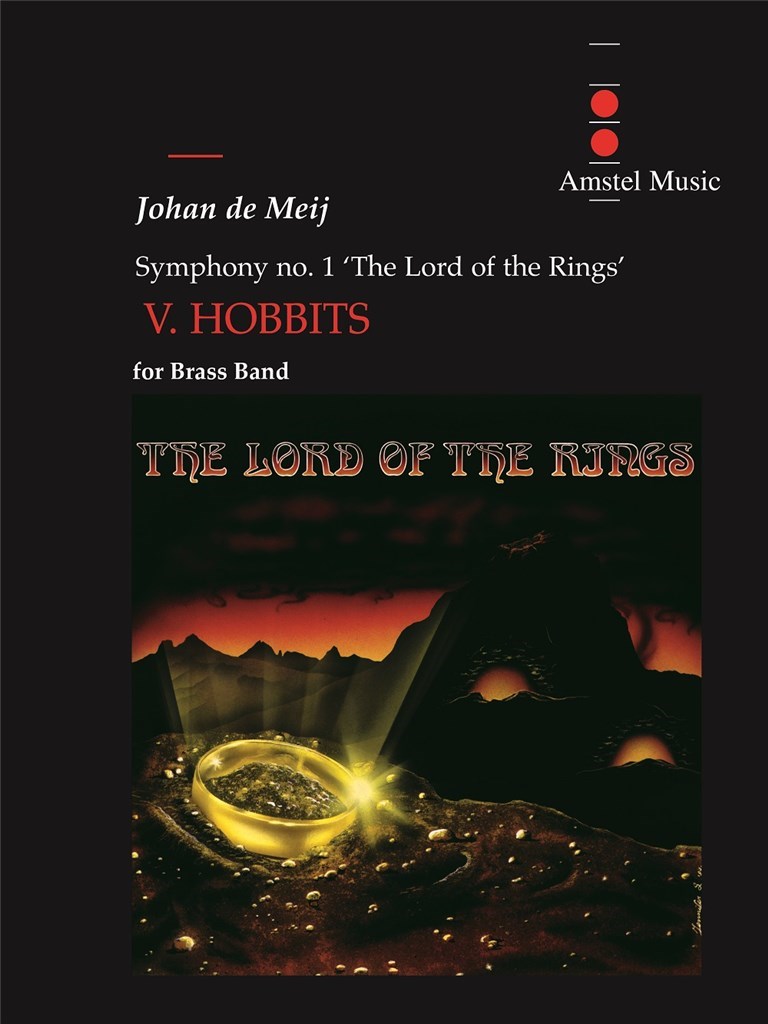
Hobbits (from Symphony No.1: The Lord of the Rings) (Brass Band - Score and Parts) - De Meij, Johan
Johan de Meij's first symphony The Lord of the Rings is based on the trilogy of that name by J.R.R. Tolkien. This book has fascinated many millions of readers since its publication in 1955. The symphony consists of five separate movements, each illustrating a personage or an important episode from the book. This transcription for brass band has been arranged by the composer. The symphony was written in the period between March 1984 and December 1987, and had its premiere in Brussels on 15th March 1988, performed by the The Royal Band ofthe Belgian Guides under the baton of Norbert Nozy. In 1989, the symphony The Lord of the Rings was awarded a first prize in the Sudler International Wind Band Composition Competition in Chicago, and a year later, the symphony was awarded a grant by the Dutch Composers Fund. In 2001, the orchestral version was premiered by the Rotterdam Philharmonic Orchestra and recorded by the London Symphony Orchestra. Duration: 9.00
Estimated dispatch 7-14 working days
-
 £90.00
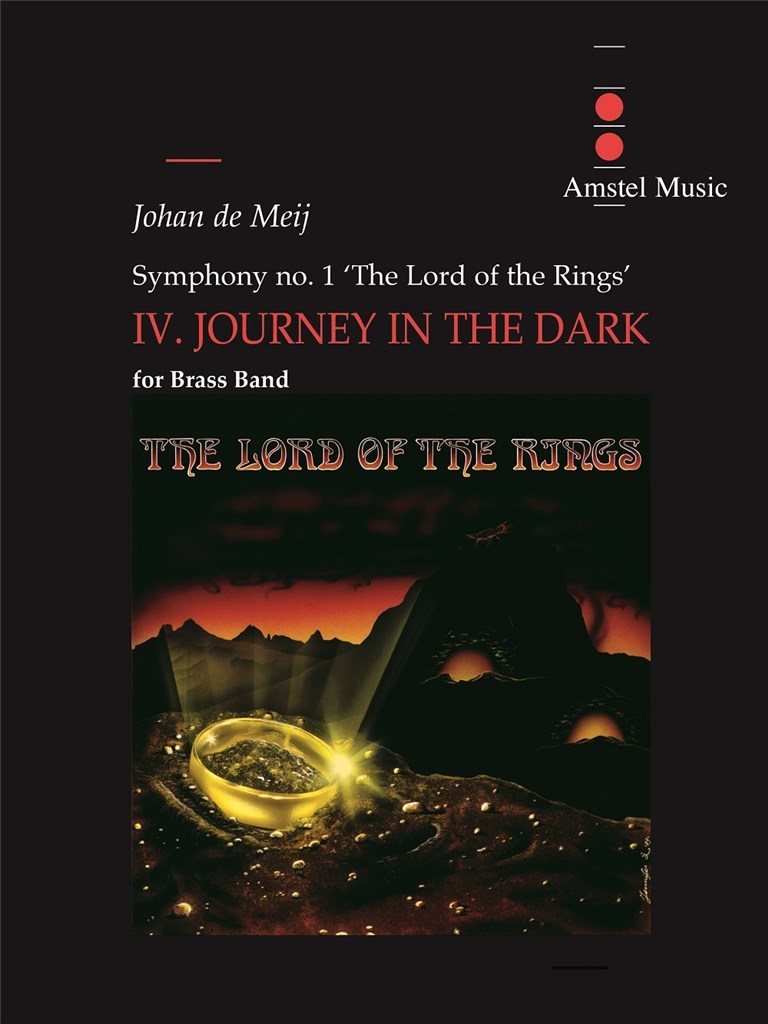
Journey in the Dark (from Symphony No.1: The Lord of the Rings) (Brass Band - Score and Parts) - De Meij, Johan
Johan de Meij's first symphony The Lord of the Rings is based on the trilogy of that name by J.R.R. Tolkien. This book has fascinated many millions of readers since its publication in 1955. The symphony consists of five separate movements, each illustrating a personage or an important episode from the book. This transcription for brass band has been arranged by the composer. The symphony was written in the period between March 1984 and December 1987, and had its premiere in Brussels on 15th March 1988, performed by the The Royal Band ofthe Belgian Guides under the baton of Norbert Nozy. In 1989, the symphony The Lord of the Rings was awarded a first prize in the Sudler International Wind Band Composition Competition in Chicago, and a year later, the symphony was awarded a grant by the Dutch Composers Fund. In 2001, the orchestral version was premiered by the Rotterdam Philharmonic Orchestra and recorded by the London Symphony Orchestra. Duration: 9.00
Estimated dispatch 7-14 working days
-
 £42.00
Mr Bojangles (Bb Instrument Solo with Brass Band - Score and Parts) - Richards, J. J. - Griffiths, David
This arrangement by David Griffiths, made especially for Tom Hutchinson, is based around the version featured on the 2001 album, 'Swing When You're Winning' by the British pop singer Robbie Williams. Suitable for 2nd Section Bands and above
Estimated dispatch 7-14 working days
-
 £34.95
Lifestream (Brass Band - Score and Parts) - Pearce, Ralph
This march is modelled on the well-known American quick march called Midwest by J.J. Richards. The melody of the second subject is by the Danish hymn-writer, Sophie Hedvig Dedakam and is associated with words by Major Clara Vint who helped to establish En Evant, the French War Cry. The title of the march is derived from the text of the song.
Estimated dispatch 7-14 working days
-
£17.50
Lifestream (Brass Band - Score only) - Pearce, Ralph
This march is modelled on the well-known American quick march called Midwest by J.J. Richards. The melody of the second subject is by the Danish hymn-writer, Sophie Hedvig Dedakam and is associated with words by Major Clara Vint who helped to establish En Evant, the French War Cry. The title of the march is derived from the text of the song.
Estimated dispatch 7-14 working days
-
 £35.00
Nimrod (from Enigma Variations) (Brass Band - Score and Parts) - Elgar, Edward - Littlemore, Phillip
Elgar wrote his Enigma Variations between 1898 and 1899. It is without a doubt Elgar's best-known large scale composition, and is dedicated to 'my friends within', as each variation is an affectionate portrayal of one of his circle of close acquaintances. The ninth variation, Nimrod, is dedicated to Augustus J. Jaeger, Elgar's publisher at Novello & Co. and also his editor and close friend. The name of the variation refers to 'the mighty hunter before the Lord' and can be found in the Book of Genesis. The name J?ger is German for hunter. Often used for solemn occasions, it is the most poignant and beautiful pieces of British music. Duration: 4:00
Estimated dispatch 7-14 working days
-
£72.99
Return to Neverland (Brass Band - Score and Parts)
Return to Neverland is a selection of melodies from the film of the same name, which was inspired by the timeless book by J J Barrie. This skilful arrangement interweaves fragments of the main melodies to make a fun and exciting work for brass band. 08:00
Estimated dispatch 7-14 working days
-
 £38.80
SHIELD OF LIBERTY (Brass Band Marchcard) - Richards, J. J. - Newsome, Roy
Grade: medium
Estimated dispatch 7-14 working days
-
 £65.00
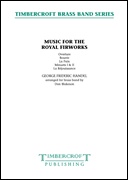
Royal Fireworks, Music from the (Brass Band - Score and Parts) - Handel, George Frideric - Blakeson, Don
Handel's Music For The Royal Fireworks was composed in 1749 to celebrate the signing of the Treaty of Aix-la-Chapelle and the end of the War of the Austrian Succession. The site chosen was the fashionable upper part of St. James Park, which was becoming known at that time as Green Park. The Green Park 'Machine', which housed the pyrotechnics was an elaborate affair adorned with "statues and other figures, festoons of flowers, and other lustres". It was announced that there would be some 10,000 rockets and other devices to be let off, all culminating in a grand, burning sun with 'Vivat Rex' at its centre. There were also rumours that the event was to be accompanied by an impressively large band of military music and mention was made of "40 trumpets, 20 french horns, 16 hautboys (oboes), 16 bassoons, 8 pairs of kettle drums, 12 side drums, a proper number of flutes and fifes; with 100 cannon to go off singly at intervals". It is unlikely that Handel had ever conceived such forces and it was merely the promoter's hyberbole, not least because it was unlikely that there were sufficient numbers of extra military musicians available that could read music, as most played from memory. It is also likely that Handel, and his publisher, were conscious that future performances would be hindered by such forces. The autographed score lists the instrumentation as 9 trumpets, 9 french horns, 24 hautboys, 12 bassoons, 3 pairs of kettle drums and up to 4 side drums. The work is in five movements, although Handel's original score did not indicate in which order they should be played. However, in this score they are arranged to be played as follows: Overture; Bour?e; La Paix; Minuets; La R?jouissance. Duration: 19:00
Estimated dispatch 7-14 working days
 View Music